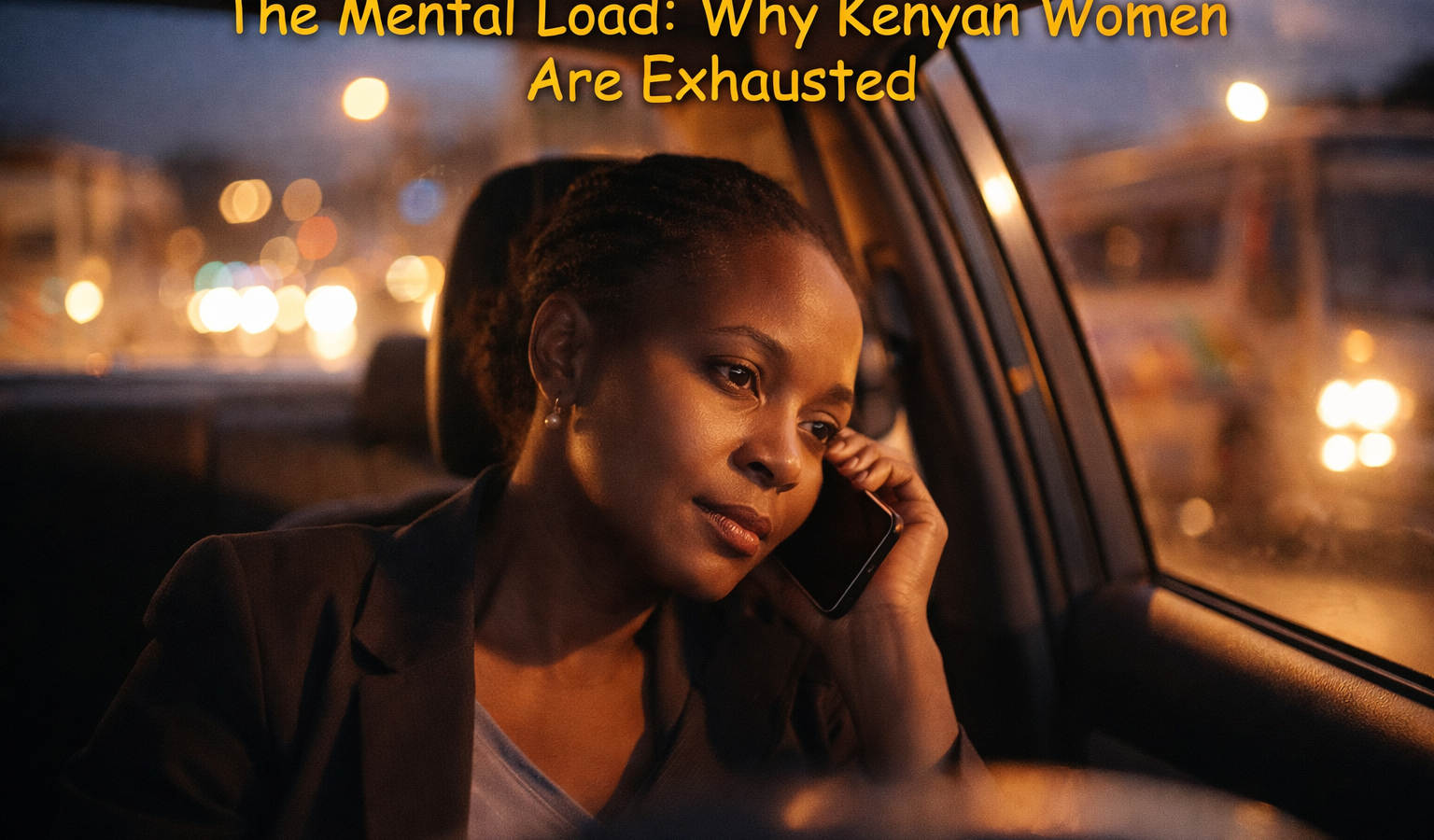
She locked her laptop at exactly 5:04 pm.
By 5:47, she was at Naivas, mentally running through tomorrow’s lunch menu while texting the house help about the plumber who never showed up.
By 6:15, she was in traffic on Mombasa Road, on a call with her sister about their mother’s medication, while also remembering that her youngest needed a birth certificate photocopy for school by morning.
She had not eaten since noon.
Her head hurt. Her jaw was clenched — she only noticed because she caught herself grinding her teeth at the traffic lights.
And somewhere between the Nyayo roundabout and her estate gate, a thought arrived that has been arriving every evening for months:
I am exhausted. But I haven’t done anything to deserve being this tired.
Sound familiar?
If you’re a Kenyan woman and that sentence hit you somewhere in the chest, this article is for you.
Not because something is wrong with you.
But because what you’re carrying has a name. It has research behind it. And it has consequences that most people around you can’t see.
It is called the mental load.
And until you learn to recognise it, you can’t begin to put it down.
What Is the Mental Load, And Why Does It Hit Women Harder?
The mental load isn’t housework.
It isn’t childcare. It isn’t even working long hours.
It is the invisible cognitive and emotional labour of managing a household and caring for the well-being of others — the constant thinking, planning, anticipating, remembering, and worrying that sits underneath every visible task.
It is remembering that the gas is running low.
It is tracking which child had a cough last night and whether they need a doctor.
It is knowing that your mother-in-law’s birthday is on Thursday and nobody else will organise anything.
It is holding the family’s entire operating system in your head — while also being expected to perform at your job, contribute emotionally to your marriage, and still somehow “make time for yourself.”
Here’s the research:
A 2024 study conducted in Nairobi found that when women were exposed to mental load triggers during work tasks, their productivity dropped by 0.25 standard deviations. The researchers concluded that the invisible family load functions as a persistent background drain on women’s cognitive resources, and it directly contributes to the gender earnings gap in Kenya. (Vitellozzi, Cecchi & Rapallini, European Economic Review, 2025)
The same study found no equivalent loss in productivity among men.
Not because men don’t care about their families.
But because in most Kenyan households, even dual-income ones, the default project manager of family life is still the woman.
Working Twice, Counted Once: The Kenyan Reality
Kenya’s 2021 Time Use Survey — the country’s first — finally put numbers to what most women already knew. (KNBS / UN Women / World Bank, 2021)
- Women spent 25.8 billion hours on unpaid domestic and care work in a single year. Men: 4.8 billion.
- Women spent 7 times as much time on unpaid care work as men. Five times more on unpaid domestic work.
- Food preparation alone consumed 14 billion hours of women’s time.
- Childcare and instruction: 2.9 billion hours for women versus 310 million for men.
The Kenya National Bureau of Statistics acknowledged that if unpaid care work were included in national accounts, it would be among the largest sectors of the economy — surpassing manufacturing and transportation.
And yet none of it appears on any payslip. Any performance review. Any CV.
The Kenyan social script makes this harder still. Many women in Nairobi and beyond are navigating what researchers call a “double bind”: social norms that assign women the lion’s share of domestic responsibility, while simultaneously expecting them to participate fully in the labour market.
You’re supposed to be a present mother, an attentive wife, a reliable daughter, a competent professional, and a community participant — all without complaint.
And ideally, while looking put-together.
The cost of this isn’t just fatigue.
It is your health.
What That Exhaustion Actually Is
The bone-deep tiredness that sleep doesn’t fix.
The irritability that feels disproportionate.
The sense of being simultaneously overwhelmed and numb.
That isn’t laziness. It isn’t poor time management.
It is the physiological consequence of a nervous system that never fully rests.
When you’re carrying the mental load, your brain is in a state of low-grade hypervigilance. This sustained activation produces what clinicians recognise as burnout: emotional exhaustion, depersonalisation, and a reduced sense of personal accomplishment. To understand more about how chronic stress affects the nervous system, see: Understanding Anxiety in Kenya: Why Your Body Feels Like It’s Always Waiting for Bad News.
Approximately 3.7 million Kenyans out of a working population of 24.9 million are living with mental health conditions. Stress, burnout, and overwork contribute to about 36 per cent of work-related diseases in the country. (Kenya Mental Health Investment Case, 2021 / Amref Health Africa)
Women carry a disproportionate share of that burden.
In our clinical practice at Clarity Counseling & Training Centre, we see this pattern constantly. Women who present with:
- Sleep disturbance
- Unexplained body pain
- Chronic tension headaches
- Digestive problems
- A persistent feeling of running on empty
Many have seen multiple doctors for physical complaints that have no clear medical cause.
What they haven’t done — because nobody suggested it — is talk to a therapist about the invisible weight they are carrying.
The women who come into our therapy rooms aren’t broken. They are carrying more than anyone was designed to carry, with fewer support systems than they deserve. — Senior Therapist, Clarity Counseling & Training Centre
The Emotional Labour Nobody Talks About
The mental load isn’t only logistical.
There’s an emotional dimension that is even harder to name.
It is being the person who remembers to check in on your friend after her miscarriage.
It is managing your husband’s mood so the evening stays peaceful.
It is absorbing your teenager’s anxiety about exams while pretending your own anxiety about money doesn’t exist.
It carries the emotional temperature of every room you walk into and adjusts accordingly.
This is emotional labour — the work of managing your own and other people’s feelings to maintain relationships and household harmony. Unpaid. Unacknowledged. Culturally invisible. If this resonates, you may also recognise yourself in: When Supporting Others Costs You Everything: Rebuilding Your Capacity to Care.
In Kenya, it is often framed as what a “good woman” simply does.
The problem isn’t that women care.
The problem is that the caring is assumed, unreciprocated, and infinite.
And when the well runs dry — when the woman who holds everything together starts to unravel — the people around her are genuinely shocked.
They didn’t see the load because it was designed to be invisible.
Five Starting Points That Are Not “Take a Bubble Bath”
If you’re reading this and recognising yourself, the worst thing anyone can tell you is to practise more self-care.
You don’t need a face mask.
You need structural change, honest conversations, and professional support.
Here is where to start:
1. Name it.
The first step is language. You can’t negotiate a redistribution of something nobody has words for.
Start calling it what it is: the mental load.
When your partner says, “Just tell me what to do,” recognise that the telling is itself the work. You aren’t asking for help with tasks. You are asking for someone to co-own the thinking.
2. Audit it.
Write down every invisible task you do in a week.
Not just cooking and cleaning — but remembering, scheduling, emotional monitoring, and anticipating.
Most women are stunned by the length of their list.
This isn’t an exercise in martyrdom. It is evidence for yourself and for the conversation that follows.
(Download our free Mental Load Audit Worksheet to get started.)
3. Renegotiate, don’t delegate.
Delegation still keeps you as the manager.
What you need is a transfer of ownership. That means your partner doesn’t just “help with” school drop-offs — they own the entire process, from packing the bag to checking the homework folder.
This is hard. It requires letting go of control, tolerating a different standard, and sitting with the discomfort of not being needed in the way you have been trained to be.
4. Let some things fall.
This is perhaps the most radical act for a Kenyan woman: allowing something not to get done.
The birthday party that doesn’t happen. The extended family obligation you decline. The meal that is ordered in instead of cooked from scratch.
The world won’t end.
And the guilt you feel about it? That guilt is a symptom, not a truth.
5. Talk to a professional.
The mental load doesn’t resolve itself with willpower. If you have been carrying this weight for years, there may be layers of resentment, grief, anxiety, and identity questions underneath it that need careful, supported exploration. To understand what stress at work can do to your mental health when the load is already heavy, see: Is Stress at Work Affecting Your Mental Health?
A therapist won’t tell you to do more yoga.
A therapist will help you understand why you feel responsible for everything, where that pattern started, and how to build a life that doesn’t require you to disappear in order to hold everyone else together. Learn about individual therapy at Clarity Counseling.
A Note for HR Professionals: This Is a Workplace Issue
If you work in human resources, employee wellness, or organisational leadership, the mental load isn’t just personal. It is a productivity and retention issue. Read: 5 Signs Your Organisation Needs Employee Wellness Training.
The Nairobi study found that mental load directly reduces women’s work output. In 2020, mental health conditions cost the Kenyan economy an estimated KES 62.2 billion (Kenya Mental Health Investment Case, 2021).
Organisations that invest in women’s mental health — through employee assistance programmes, flexible work arrangements, and subsidised counseling — aren’t just being compassionate.
They are being strategic.
Clarity Counseling & Training Centre works with organisations across Kenya to design and deliver employee wellness programmes, mental health first aid training, and facilitated support groups.
If your workforce includes women who are silently carrying the mental load, the cost of doing nothing is higher than you think.
You Deserve to Be Held, Too
Here’s something nobody says to the woman holding it all together:
You deserve to be held, too. Not held together. Not held accountable. Not held to impossible standards. Just… held. Listened to. Seen. Given the space to put things down for an hour and breathe.
That’s what therapy is.
Clarity Counseling & Training Centre offers individual therapy with experienced, licensed therapists who understand the specific pressures Kenyan women face. In person or online — whichever fits the life you’re juggling.
Not sure whether therapy is right for you? Start with our free Mental Load Audit Worksheet. It takes ten minutes.
It might be the first time you see, on paper, what you’ve been carrying in your head.
And once you see it?
You can finally start deciding what to keep and what to put down.
Book a Women’s Wellness Consultation
Book Now at www.pcbuilds.site/sp/contact-us
+254 (0) 114 444 300
Individual therapy • Couples therapy • Workplace wellness programmes
NITA • TVETA • KCPA Accredited