If you or someone you know is struggling, call the Kenya Red Cross toll-free helpline: 1199. Or reach Clarity Counseling: +254 (0) 114 444 300.
She was 26 years old.
Dr. Desree Moraa Obwogi. Medical intern at Gatundu Level 5 Hospital in Kiambu County.
On the Sunday before she died, she’d finished a 36-hour shift. There were no nurses to assist her — they were on strike. She hadn’t been paid since she started. The Friday before, she’d had an altercation with a senior supervisor that a colleague later described as crushing.
She went home to the one-bedroom apartment she shared with a fellow intern near the hospital. The building’s caretaker greeted her as she walked in.
He said she was quiet. She was always quiet.
She didn’t come out again.
Her colleagues described her as dedicated. The kind of person who became a doctor because she wanted to heal people.
The Ministry of Health, after her death, launched a national workplace mental wellness programme. But that programme came too late for Desree.
I don’t know if Desree went to church. I don’t know what she believed. But I know this:
In a country where 85% of people are Christian, the chances are high that someone in her life — a parent, an aunt, a friend — told her to pray about it. To give it to God. To trust that this season would pass.
And maybe she did pray. Maybe she prayed every night.
But what she needed alongside that prayer was a trained professional who could recognise clinical depression, who could intervene with evidence-based tools, who could hold what she was carrying in a way that prayer alone was never designed to hold.
This post is about that gap.
The space between what the church offers and what a person in crisis actually needs.
And why prayer and therapy aren’t competing — they’re two hands of the same God.
Why Mental Health Stigma Persists in Kenyan Faith Communities
The unspoken rule
In many Kenyan churches — Catholic, Anglican, Pentecostal, independent — there’s an unspoken hierarchy of acceptable suffering.
Physical illness? Go to the hospital. Kenyatta, Aga Khan, Avenue. Nobody questions you. The church even organises a harambee for the bill.
Mental illness? Fast longer. Pray harder. Your faith is the problem.
A 2024 study surveyed Christian students at the University of Nairobi and found that mental health stigma in church was directly linked to beliefs about spiritual causes of distress. In Pentecostal and charismatic congregations, some respondents reported being told their depression was evidence of demonic activity (Africa International University, Impact: Journal of Transformation, 2024).
Others said their anxiety was framed as doubt. As if trusting God and having a panic attack can’t coexist.
If a church member fell and broke their femur during fellowship, would the pastor say, “Let’s pray it straight”? Or would someone call an ambulance?
Depression is a condition of the brain. The brain is an organ. When organs malfunction, they need professional treatment — the same way a broken bone needs an orthopaedic surgeon, not just intercessory prayer.
That’s not a failure of faith. It’s an acknowledgement of how God designed the body.
Does the Bible Support Christians Going to Therapy?
People assume the Bible says “handle everything alone with God.” But here are some verses that speak to seeking help from others — and God uses men to help men.
Proverbs 11:14 — “Where there is no guidance, a people falls, but in an abundance of counsellors there is safety.” Counsellors. Plural. Not just the pastor. Not just the prayer warrior.
Galatians 6:2 — “Bear one another’s burdens, and so fulfil the law of Christ.”
James 5:16 — “Confess your sins to one another and pray for one another, so that you may be healed.”
And Mark 2:17 — Jesus himself: “It is not the healthy who need a doctor, but the sick.”
Read that again. Jesus didn’t say, “The sick don’t need doctors — they need more faith.” He acknowledged that when you’re unwell, you go to someone who can help you heal.
A therapist trained in evidence-based practices is a healer. Their tools are different from a pastor’s. But they’re not less God-given. A stethoscope is as much a gift from God as a prayer shawl.

Christian Counseling in Kenya: How Prayer and Therapy Work Together
We are not saying stop praying, because we know prayer is real and it works. Meditation and contemplative prayer have documented neurological effects — they reduce amygdala reactivity, lower cortisol, and improve emotional regulation (PMC, 2024). So prayer is literally changing your brain. Science confirms what you’ve always felt.
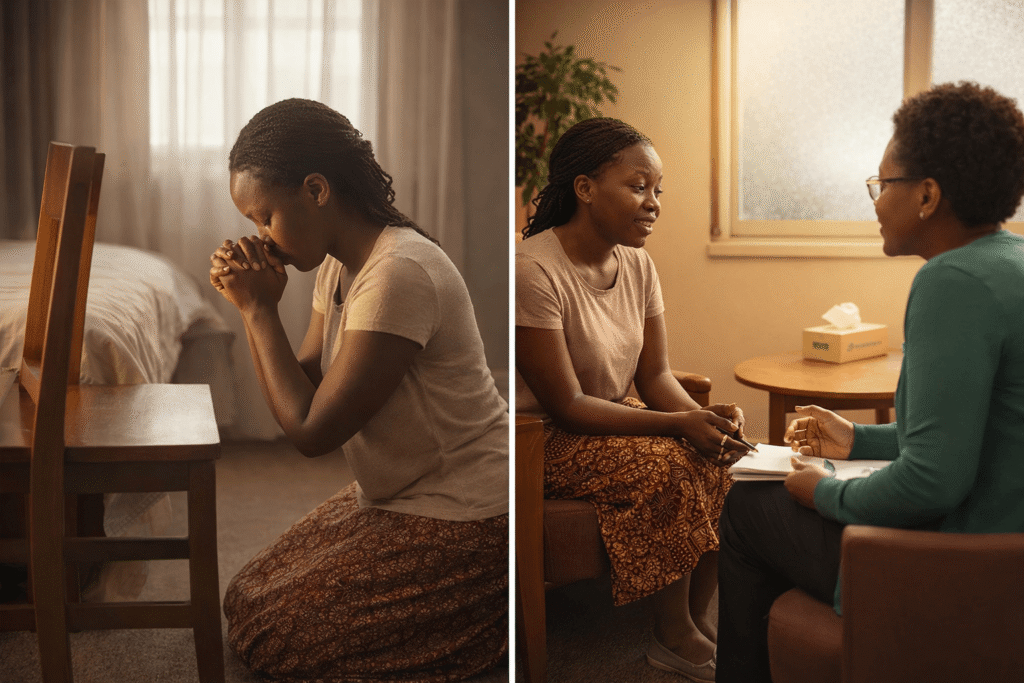
But prayer and therapy serve different purposes, the same way bread and water both nourish you, but through different mechanisms.
Prayer connects you to God. Therapy helps you understand yourself.
Prayer offers comfort and hope. Therapy offers structured strategies for managing specific symptoms.
Prayer sustains you in the storm. Therapy helps you understand why you keep ending up in the same storm — and builds a different route out.
They’re not competing. They’re working on the same person. Through different doors.
Dr Gladys Mwiti — a Kenyan clinical psychologist, founder of Oasis Africa, and Catalyst for the Lausanne Movement’s Global Mental Health and Trauma initiative — has written extensively about this. She argues that churches in Africa are strategically placed to address mental health alongside trained professionals.
As she and Dr Bradford Smith wrote: “God has strategically placed churches to meet the needs of those with mental health problems — through Biblical teaching, prayer, fellowship, hospitality, caring, counselling, and advocacy for justice.”
Notice that counselling is in that list. Right between caring and advocacy. Not separate from the church’s mission. Part of it.
When Should a Pastor Refer to a Mental Health Professional?
Pastors are often the first person a family calls during a mental health crisis (APA, 2020). In Kenya, this is even more true. The pastor knows the family. The pastor is trusted. The pastor is accessible.
But most pastors aren’t trained clinical professionals. And they don’t need to be. What they need is the wisdom to know when to hold and when to hand it over.
Here are six signs a congregant needs more than pastoral care:
- One: symptoms lasting more than two weeks. Persistent sadness. Withdrawal from things they used to enjoy. Insomnia or sleeping all the time. Not a bad week — a pattern.
- Two: suicidal thoughts or self-harm. This is not a prayer request. It’s a medical emergency. Refer to a professional immediately while continuing to offer spiritual support alongside.
- Three: history of trauma. Abuse, violence, displacement, bereavement. Trauma requires specialised intervention from someone trained to hold it safely.
- Four: substance dependence. When alcohol or drug use is escalating. In Meru, the Holy Innocents BPSS Centre — run by Catholic sisters — combines clinical therapy, medical detox, and spiritual guidance under one roof (Vatican News, 2026).
- Five: relationship crisis that’s escalating. Domestic violence. Severe marital conflict. Parenting breakdowns.
- Six: When the same person keeps coming back for the same issue. That’s not a lack of faith. It’s a signal that what they’re carrying is beyond what pastoral care alone can resolve.
Referring is not abdication. It’s wisdom. You’re not losing a sheep. You’re getting them a shepherd who specialises in their particular wilderness.
How Churches Can Support Mental Health: 5 Practical Steps
You don’t need a psychology degree or a funding proposal. The Lausanne Movement and CHAK recommend:
One: Talk about it from the pulpit. Dr. Ed Stetzer of Wheaton College says, “Sermons stop stigma.” When a pastor normalises mental health from the front — even once — it gives every person in every pew permission to say, “I’m not okay.”
Two: Train your leaders. A basic counselling skills course gives pastors, deacons, and ministry heads the tools to recognise signs, respond with empathy instead of theology, and know when to refer.
Three: Build a referral relationship. Know the name, number, and face of at least one licensed therapist or counselling centre. When a congregant needs clinical help, you don’t scramble. You have a trusted place to send them.
Four: Create honest spaces. Not every small group needs to be a Bible study. Some could be spaces where people share without being fixed, where “I’m struggling” is met with “me too” instead of “let me pray for you.”
Five: Stop equating mental illness with spiritual weakness. Say it out loud: depression is not punishment. Anxiety is not doubt. Trauma is not a character flaw. Therapy is not a lack of faith.
When a church gets this right, it doesn’t lose spiritual authority. It gains it. Because a church that can hold both faith and brokenness — without flinching at either — is a church that can hold anyone.
Faith-Based Mental Health Care in Kenya: The Untapped Opportunity
One in four Kenyans seeking healthcare has a mental health condition (WHO).
Kenya’s population is approximately 85% Christian.
The Christian Health Association of Kenya represents faith-based health facilities that provide nearly 40% of Kenya’s healthcare services.
Read those three facts together: the largest untapped mental health infrastructure in the country is sitting in church buildings. Every Sunday.
A 2024 systematic review in the Christian Journal for Global Health confirmed it: across Africa, faith-based entities are already the primary mental health touchpoint for millions. But they’re under-resourced and under-trained.
The church doesn’t need to become a clinic. It needs to become a bridge. Between suffering and professional care. Between stigma and understanding. Between “pray it away” and “let’s find you the right support.”
Can Prayer and Therapy Work Together? A Letter to the Believer
To the one who’s been performing strength
If you recognised yourself in this post — the person who lifts their hands on Sunday and can’t lift their head on Tuesday — hear me.
You have not failed God.
God did not give you the intelligence to recognise your pain and then expect you to ignore it. He didn’t create the brain’s capacity to heal and then forbid you from accessing that healing. He didn’t place therapists in the world and then say, “Don’t use them.”
Psalm 34:18: “The Lord is close to the brokenhearted and saves those who are crushed in spirit.”
Sometimes He saves through medicine. Sometimes through community. Sometimes, through a trained therapist sitting across from you, asking the one question nobody in your life has ever asked:
“How are you, really?”
Not “how’s your faith?” Not “are you praying enough.”
Just: how are you?
You deserve to answer that question honestly. And you deserve a space where the answer is met with both grace and evidence.
That’s not a betrayal of your faith.
It’s the fullest expression of it.
View this post on Instagram
Schedule a community training session with Clarity Counseling.
www.pcbuilds.site/sp/ | +254 (0) 114 444 300 | NITA | TVETA | KCPA Accredited