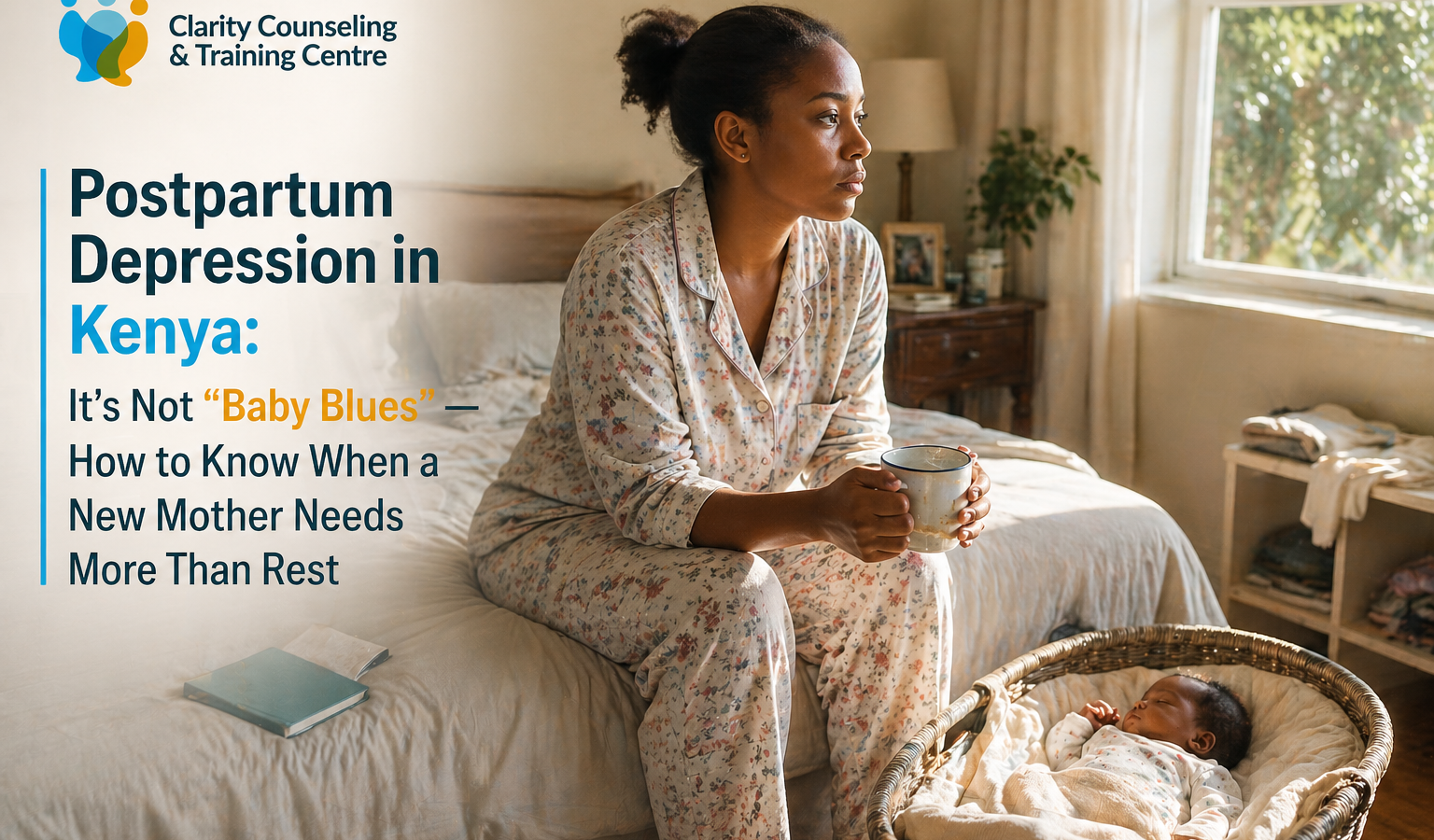
Everyone said it would be the happiest time of your life.
You waited for it. You prayed for it. The pregnancy was hard, but you got through. The baby is here. Healthy. Beautiful. The visitors keep coming with chai and soup and “ah, mama, you are blessed.”
And you are blessed. You know you are. You can see this baby is a miracle. That is what makes it so terrifying that you feel nothing.
Or worse — that you sometimes feel a flicker of resentment when she cries again at 2 am. That you have started avoiding the mirror. Last week, you sat in the bathroom and wondered, just for a second, what would happen if you walked out the front door and never came back.
You have not told anyone. Who would you tell? Your husband would not understand. Your mother-in-law would say you are ungrateful. Your church friends would pray over you with that look. So you smile when people ask. You say, “I am fine, just tired.”
You are not fine. And what you are experiencing has a name. It is called postpartum depression, and in Kenya, it affects roughly one in five new mothers — most of whom never get help.
What Is Postpartum Depression?
Postpartum depression (PPD) is a clinical mood disorder that develops in the weeks or months after childbirth. It is not weakness, not a character flaw, and not a sign that you are a bad mother.
It is a real medical condition driven by a combination of hormonal shifts, sleep deprivation, identity upheaval, social pressure, and often unresolved life stress. If any of this resonates, therapy in Kenya is a safe starting point.
In Kenya, multiple peer-reviewed studies put the prevalence of PPD between 10% and 27%. A study at Kenyatta National Hospital found a prevalence of 10.6% at six weeks postpartum. A study at Aga Khan University Hospital found a 13.8% rate.
A more recent study at Eldoret West Maternity Hospital found a 17.5% rate. Among adolescent mothers in Nairobi’s informal settlements, prevalence has been measured at 24% to 29.7%. Among HIV-positive Kenyan mothers, rates as high as 48% have been documented. In rural Kenya, recent research puts perinatal depression at 19% to 27%.
Translation: if you are a new mother in Kenya feeling something is deeply wrong, you are not alone. You are part of a population of hundreds of thousands of Kenyan women that the system has been failing for decades.
How Is PPD Different From Baby Blues?
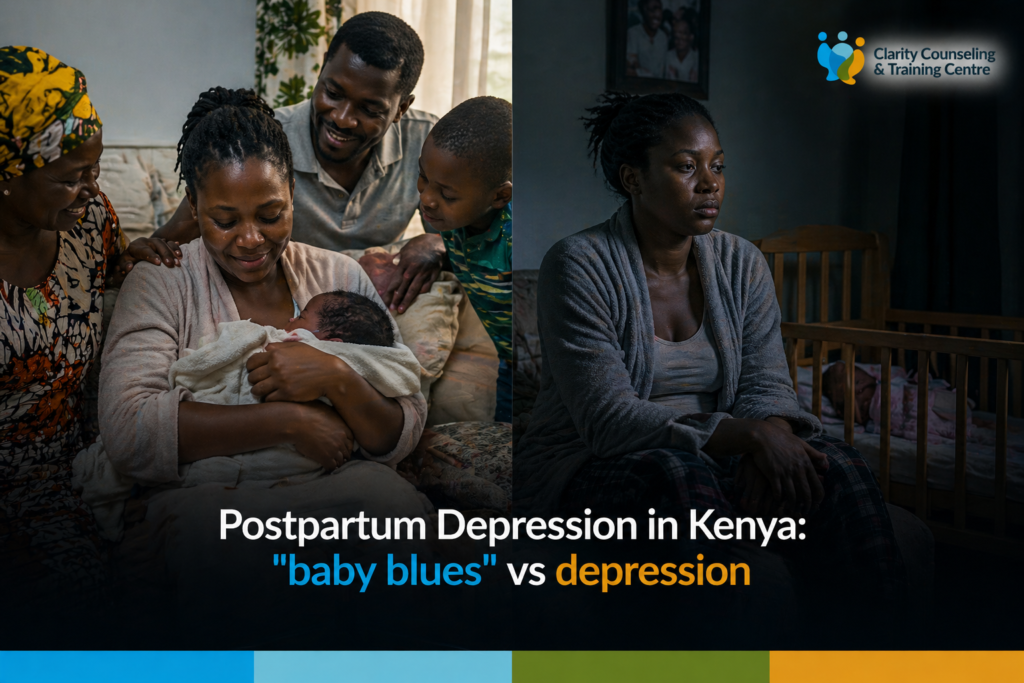
This is the single most important distinction every new Kenyan mother and her family need to understand.
Baby Blues
- Affects up to 80% of new mothers globally
- Starts within 2 to 3 days after delivery
- Caused by the dramatic hormonal drop right after birth
- Symptoms: tearfulness, mood swings, mild anxiety, feeling overwhelmed
- Resolves on its own within 2 weeks
- Does not require medical treatment, just rest, support, and time
Postpartum Depression
- Affects roughly 10–27% of Kenyan mothers
- Can start anytime in the first year after delivery, most often weeks 2 to 6 onwards
- Caused by a combination of hormones, sleep deprivation, psychosocial stress, and biological vulnerability
- Symptoms: persistent sadness or numbness, loss of interest, sleep disturbance beyond what the baby causes, intrusive thoughts, irritability, hopelessness, and sometimes thoughts of harming yourself or the baby
- Lasts months or longer if untreated, often becoming chronic
- Requires professional treatment — therapy, sometimes medication, and social support
Rule of thumb: if it has been more than 2 weeks since delivery and you are still struggling, or if your symptoms are getting worse rather than better, this is no longer baby blues. It is time to be properly assessed.
What Are the Symptoms of Postpartum Depression?
PPD does not always look like crying. In Kenyan mothers, it often shows up in these ways:
Emotional Symptoms
| Symptom | Description |
| Persistent sadness, emptiness, or hopelessness | Ongoing low mood that feels heavy and difficult to shake |
| Feeling numb | Unable to feel love or joy for your baby (often one of the most distressing and under-discussed symptoms) |
| Excessive guilt | Feeling like a bad mother, no matter what you do |
| Irritability | Snapping at your husband, older children, helpers, or parents-in-law |
| Anxiety | Racing thoughts and constant worry that something terrible will happen to the baby |
| Intrusive thoughts | Disturbing images or thoughts that come unbidden (these do not mean you will act on them) |
- Persistent sadness, emptiness, or hopelessness
- Feeling numb — unable to feel love or joy for your baby (this is one of the most distressing and most under-discussed symptoms)
- Excessive guilt — feeling like a bad mother, no matter what you do
- Irritability, snapping at your husband, older children, helpers, parents-in-law
- Anxiety — racing thoughts, constant worry that something terrible will happen to the baby
- Intrusive thoughts — disturbing images or thoughts that come unbidden (these do not mean you will act on them)
Physical Symptoms
- Sleep disturbance beyond what the baby is causing — unable to sleep even when the baby sleeps
- Appetite changes — eating much more or much less than normal
- Persistent fatigue that does not lift even after rest
- Headaches, body aches, and gastric problems with no clear medical cause
Behavioural Symptoms
- Withdrawing from family and friends
- Avoiding the baby — handing her off whenever possible
- Or the opposite: excessive checking on the baby, unable to leave her side, even when others can help
- Loss of interest in things that used to bring you joy
- Difficulty bonding with the baby
Severe Warning Signs (Seek Help Immediately)
- Thoughts of harming yourself
- Thoughts of harming the baby
- Feeling disconnected from reality, hearing or seeing things that are not there (this can be postpartum psychosis, a medical emergency)
If you are experiencing any of these severe symptoms, please call Befrienders Kenya at +254 722 178 177 or Niskize 24/7 at 0900 620 800. You can also go directly to the nearest hospital. You are not a bad mother. You are unwell, and treatment works.
Why Postpartum Depression Is So Underdiagnosed in Kenya
1. The “You Should Be Grateful” Pressure
Pregnancy and motherhood are sacred in most Kenyan cultures. The cultural script gives no room for a new mother to feel anything but joy. The moment you express anything else, you are met with: “You have a healthy baby. Why are you complaining?”
This silences mothers very effectively. It does not make the depression go away.
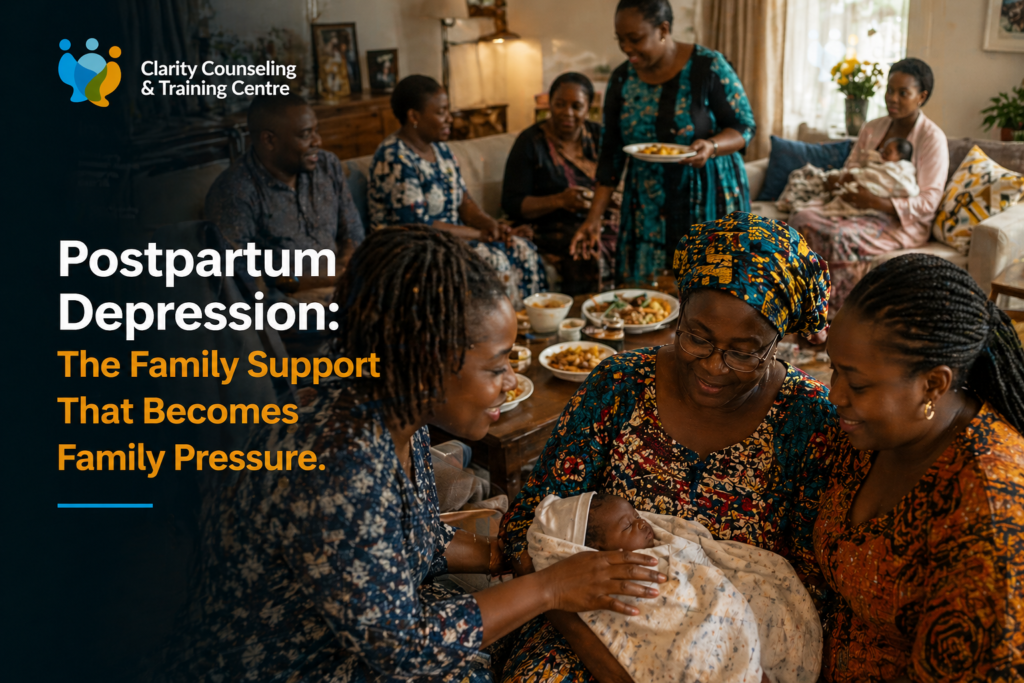
2. The Family Support That Becomes Family Pressure
In many Kenyan families, the postnatal period is a flood of relatives —mothers, mothers-in-law, aunties, sisters— all with strong opinions about everything from:
- How you should feed.
- How you should bathe.
- How you should swaddle.
- Why is your milk not enough?
- Why are you doing it wrong?
What is meant as help can become a layer of pressure that erodes the new mother’s sense of agency. The landmark Kenyan study published in BMC Psychiatry (Ongeri et al.) found that conflict with a partner during pregnancy was the single strongest predictor of postpartum depression, increasing the odds more than sevenfold.
3. Breastfeeding Pressure
Cultural expectations around exclusive breastfeeding in Kenya can be intense. Mothers who struggle to breastfeed, whose milk supply is low, who have inverted nipples or painful latching, often feel like failures. Add depression on top of this, and the shame becomes overwhelming.
4. The Healthcare System Does Not Screen for It
Most Kenyan postnatal clinic visits focus exclusively on the baby’s weight, immunisations, and feeding. The mother’s mental health is rarely asked about. Even when validated tools like the Edinburgh Postnatal Depression Scale (EPDS) exist, they are inconsistently used. Mothers who are silently struggling walk in and walk out without anyone asking the right question.
Can Breastfeeding Mothers Take Antidepressants?
Yes —under the supervision of a qualified psychiatrist. This is one of the most common questions Kenyan mothers ask, and the misinformation around it stops many women from getting medication that could help.
Several antidepressants in the SSRI family (selective serotonin reuptake inhibitors), particularly sertraline, are considered compatible with breastfeeding by the WHO and major paediatric bodies. The amount that passes into breast milk is very small, and decades of data suggest it is safe for the baby in most cases.
Important: medication is a clinical decision that must be made by a psychiatrist or doctor, not by Google or a friend’s advice. If you are considering medication, your therapist at Clarity can refer you to a Kenyan psychiatrist who specialises in maternal mental health. And if you prefer to avoid medication, that is also valid.
Therapy alone —particularly cognitive behavioural therapy and interpersonal therapy— has strong evidence for treating PPD without medication. Our guide on how to choose the right therapist in Kenya can help you find someone with maternal mental health experience.
How Therapy Helps a New Mother With PPD
1. Validation First
You will be heard without judgment. Probably for the first time in months. A trained therapist will not tell you to be grateful. They will help you name what you are feeling and begin to understand it.
2. Practical Tools for Survival Mode
Therapists do not just talk. They equip you with concrete strategies: how to manage intrusive thoughts, how to handle the in-laws, how to ask your husband for what you need, how to build small moments of relief into days that feel impossible.
3. Working on the Underlying Causes
Once you are stabilised, therapy can address the deeper drivers — partner conflict, unresolved birth trauma, identity loss, financial stress, and family dynamics. These are often the actual roots of PPD, not the hormones.
4. Couples Sessions Where Helpful
Bringing your husband into a session or two can transform the home environment. Many Kenyan husbands do not understand what their wives are going through. A therapist can translate it for him in a way that lands. Our couples therapy services are designed for exactly this.
5. Flexible Scheduling for New Mothers
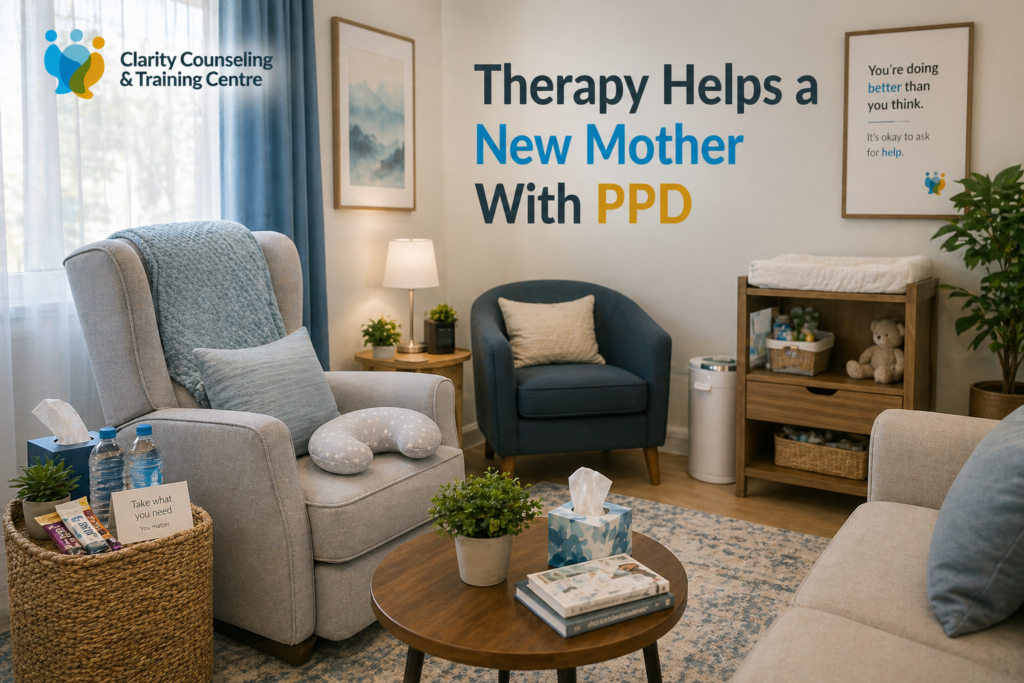
At Clarity, we know new mothers cannot always commit to a fixed weekly slot. We offer flexible scheduling, online therapy, and family-friendly rooms where you can bring the baby if you need to. Healing should not be one more impossible thing on your list.
When Should a New Mother See a Therapist?
Trust your gut. If something feels wrong, it probably is. Our full guide on signs you are ready for professional therapy goes deeper, but some specific signals it is time to book:
- It has been more than 2 weeks since delivery, and you are still struggling
- You feel emotionally flat or numb toward your baby
- You are crying daily and cannot identify why
- You are not sleeping even when the baby sleeps
- You feel hopeless about the future
- You are having intrusive thoughts that frighten you
- Your husband, mother, or close friend has expressed concern about you
- You are using alcohol or other substances to cope
- You have any thoughts of harming yourself or the baby (please seek help today, not next week)
A Note for Husbands and Family Members Reading This
If a woman you love has just had a baby and is not herself, listen to her. Do not minimize her feelings or experiences. Do not say “all new mothers feel this way.” Do not bring more relatives “to help” if she is asking for space.
What helps a Kenyan woman with PPD most:
- Take the baby for stretches so she can sleep uninterrupted
- Cook or order food without being asked
- Run interference with the extended family who are exhausting her
- Tell her she is doing a good job. Often.
- Make the call to a therapist for her if she cannot make it for herself
- Go with her to the first appointment if she would like that
Postpartum depression is treatable. Most women who get the right help recover fully. The mother she is going to be —present, loving, capable, herself— is still in there. She just needs the support to come back. And if cost is the concern, our full guide on does SHA cover therapy in Kenya explains every option available in 2026.
You Are Not Alone in This
One in five Kenyan mothers walks the road you are walking. Most do it in silence. You do not have to.
Postpartum depression is not a verdict on your worth as a mother. It is a treatable condition. With the right support — therapy, sometimes medication, practical help at home
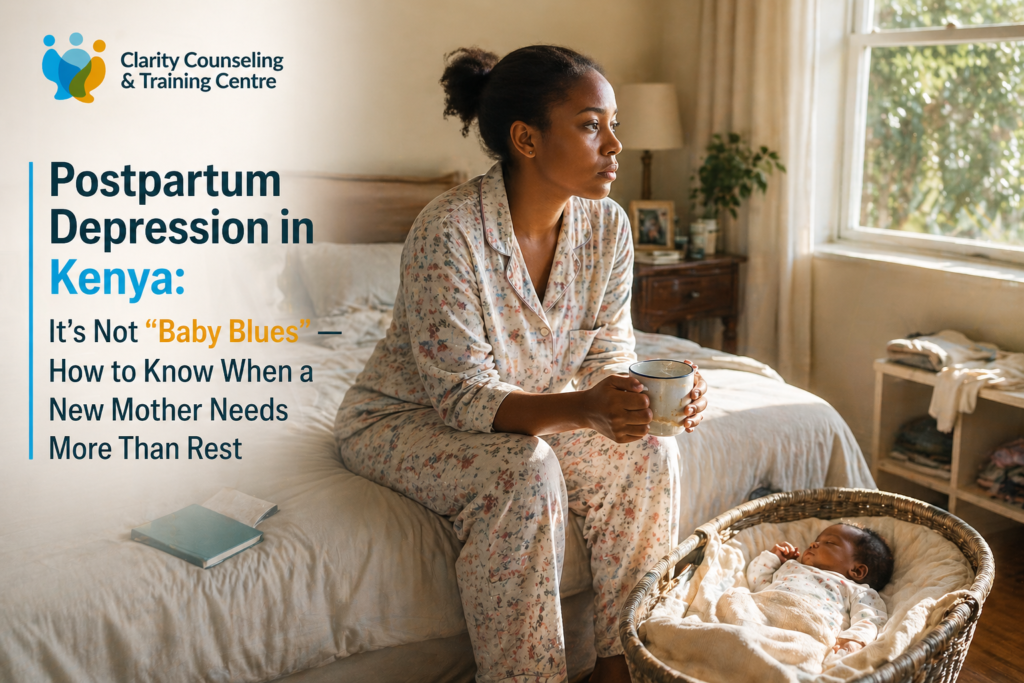
— you can come back to yourself. You can fall in love with your baby in a way you cannot right now. You can stop white-knuckling every day.
You just need to make one call.
Book a session — we offer flexible scheduling for new mums.
Clarity Counselling and Training Centre — KCPA accredited (No. KCPA/INST/0147/019), Counsellors and Psychologists Board-registered.
Sessions are KSh 3,500. Insurance accepted. In-person at Finance House, 13th Floor, Left Wing, Nairobi, and online across Kenya and the diaspora. Family-friendly rooms available —you can bring your baby.
Call: +254 114 444 300
Or visit: www.pcbuilds.site/sp/contact-us