If you or someone you know is struggling, call the Kenya Red Cross toll-free helpline: 1199. Or reach Clarity Counseling: +254 (0) 114 444 300.
On December 23rd, 2025, a man checked into a short-stay apartment on Kasuku Road in Kilimani, Nairobi.
His name was Evans Mwaura Githua. He was 51.
CEO of Com Twenty One — an IT solutions company with branches in four Kenyan towns. His clients included the State House, Parliament, the Central Bank of Kenya, and Kenya Ports Authority.
His friends described him as jovial.
He’d recently secured major business contracts.
There were no immediate indications of distress. None that anyone saw.
The next afternoon, his body was found behind Alba Apartments. He’d fallen from the 14th floor.
The news cycled through Twitter, through WhatsApp groups, through office conversations for a week. People said the same thing they always say: “I never would’ve guessed.”
That sentence is the problem.
Because the brain doesn’t announce when it’s breaking. It doesn’t send a memo. It doesn’t update your WhatsApp status.
It keeps performing. Keeps delivering. Keeps looking like success from the outside — while running on fumes, cortisol, and borrowed time on the inside.
Until it can’t.
This post isn’t about Evans. It’s about the thousands of professionals in Nairobi — in courtrooms, hospitals, classrooms, HR offices, boardrooms — whose brains are running the same pattern right now. And about what science says can actually change that pattern.
Not in years. In weeks. But briefly,
How Chronic Stress Rewires Your Brain (And Why High-Achievers Are Most at Risk)
The professional who holds everyone else together
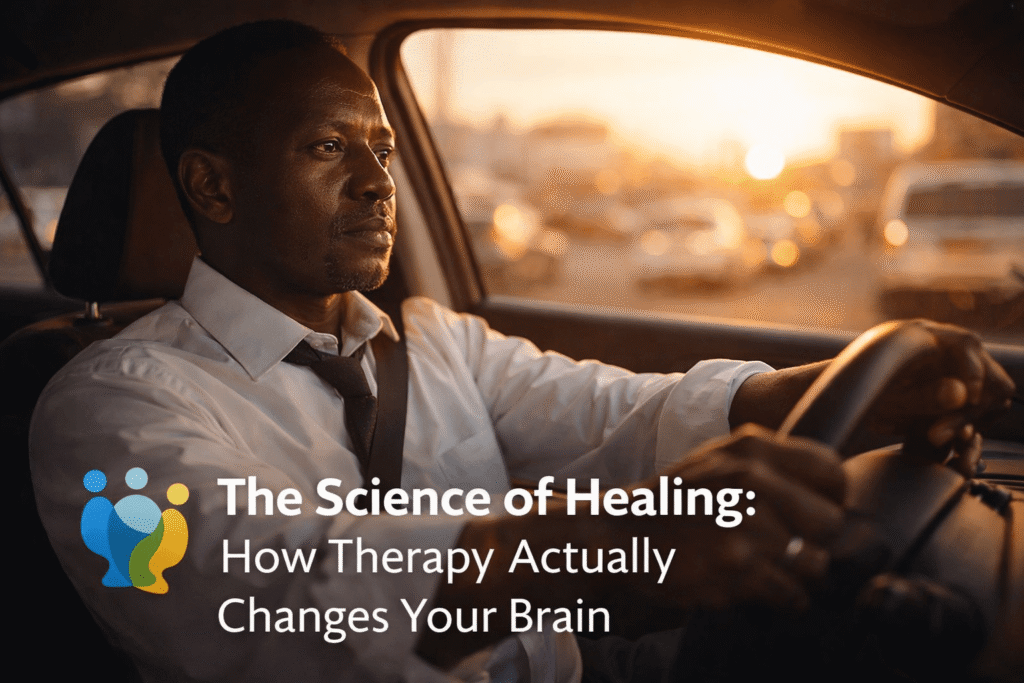
5:47 PM. Mombasa Road. The Imara Daima flyover is backed up to the Shell petrol station.
You’re sitting in your car. Engine idling. The air conditioning is fighting a losing battle against the Nairobi sun and the heat of everything you carried today.
Maybe you’re a lawyer who just spent three hours in a courtroom watching a client relive the worst day of their life. You held your face steady. You asked the right questions. You were professional.
Now you’re gripping the steering wheel at six o’clock, and your hands won’t stop shaking.
Maybe you’re a teacher who broke up a fight during lunch, called a parent about a child you suspect is being neglected at home, and then had to stand in front of thirty-five Standard 7 students and teach fractions like your heart wasn’t racing.
Maybe you’re a nurse who pronounced someone dead at 2 PM and clocked into the maternity ward at 3 PM because there was nobody to cover the shift.
Maybe you’re a HR manager who spent the afternoon mediating between a director who doesn’t think shouting is violence and an employee who flinches every time someone raises their voice.
You hold space for other people. That’s your job. That’s your calling. That’s who you are.
But right now, sitting in traffic, you’re wondering when the holding started to feel like drowning.
Someone —your partner, your pastor, your mother— has probably told you to “talk to someone.”
And the part of you that solves problems for a living wants to ask: how would talking change anything?
Fair question. Here’s the answer. And it’s not motivational. It’s medical.
What Happens in Your Brain During Anxiety and Chronic Stress
That tightness in your chest when your phone rings and you don’t want to answer it?
That’s not a weakness. That’s your amygdala.
The amygdala is a small, almond-shaped structure deep in the brain. Think of it as your internal fire alarm. Its job is to detect threats and trigger your body’s survival response —the racing heart, the shallow breathing, the surge of cortisol that makes your muscles tense and your mind hypervigilant.
When you’re working in a high-pressure environment—the hospital, the courtroom, the school, the HR office, the church—your amygdala is on duty all day. Every crisis. Every conflict. Every person who walks in with pain, you have to hold.
Over months. Over the years.
Your fire alarm stops being a fire alarm. It becomes a smoke detector that goes off when someone burns toast.
A raised voice in a meeting, and your body responds like you’re in danger. A WhatsApp message at 9 PM and your stomach drops. Your child asks you a question, and you snap — not because the question was annoying but because you have nothing left.
That’s not a character flaw. That’s a brain that’s been running in survival mode for too long without maintenance. And just like any system that runs without maintenance, something eventually gives.
How CBT Physically Rewires the Brain: The Evidence From fMRI Studies
So does therapy actually change the brain? Yes. Physically. Visibly. On a scan.
In 2016, a team of neuroscientists published a landmark study in Nature’s Translational Psychiatry. They took people whose brains were stuck in that overactive fire-alarm state — people with social anxiety disorder — and put them through nine weeks of Cognitive Behavioural Therapy.
Before and after, they scanned their brains using fMRI.
The results were physical. Measurable. Visible on the scan.
The grey matter volume in the amygdala — the fire alarm — had literally shrunk. Not metaphorically. Structurally. The brain had physically reorganised itself (Månsson et al., 2016, p = 0.02).
At the same time, the prefrontal cortex — your brain’s “wise elder,” the part responsible for rational thought, planning, and emotional regulation — became more active.
Let me translate that into your 5:47 PM on Mombasa Road.
Before therapy, the fire alarm is running your life. Every trigger activates your whole body. You’re exhausted not from the work but from the constant state of readiness your nervous system can’t switch off.
After therapy, the wise elder wakes up. Your capacity to pause before reacting, to choose your response rather than being hijacked by your stress response, takes the lead.
You still feel things. You’re still empathetic. You’re still the person people lean on. But you stop living in survival mode. And that changes everything.
Does Therapy Really Work? Scientific Evidence for Talk Therapy
One of the most common objections to therapy —especially in East African cultures— is that “just talking” can’t fix a real problem.
So does talking actually help mental health? Here’s what the data shows.
A major meta-analysis by Cuijpers et al. found that Cognitive Behavioural Therapy matched antidepressant medication in long-term outcomes for depression. Same results. Different mechanisms.
Medication changes your brain chemistry from the outside in. It adjusts the levels of serotonin, dopamine, and norepinephrine.
Therapy changes your brain from the inside out. It teaches new patterns. New responses. New neural pathways that the brain builds through practice — the same way it builds any other skill.
And here’s the part that matters: the brain changes from therapy last longer than those from medication alone. Because therapy doesn’t just treat the symptom, it rewires the circuit.
The Månsson team followed their participants for a year. The structural changes in the amygdala remained. The brain hadn’t reverted. It had learned.
A comprehensive 2022 meta-analysis in Frontiers in Psychology confirmed this across dozens of fMRI studies: CBT consistently increases prefrontal cortex activity while decreasing amygdala and default mode network reactivity.
Less emotional hijacking. More thoughtful response. That’s not willpower. It’s neuroplasticity, the brain’s documented ability to physically reorganise itself in response to new learning (Brain Research, 2025).
How Therapy Helps Professionals Manage Stress and Burnout
What this looks like on a Tuesday at 3 PM
Let’s get specific because theory means nothing if it doesn’t land in your day.
If you’re a medic, you know the difference between being tired from a long shift and being depleted from years of holding life and death. Therapy won’t make the shifts shorter. But it can stop you from carrying every patient home in your chest. Reduced amygdala reactivity means you can feel compassion without being consumed by it.
If you’re in HR, you’re the person everyone comes to with their problems, and you’re not allowed to have any of your own. Therapy gives you back the boundary between absorbing someone’s crisis and witnessing it. Your prefrontal cortex learns to hold space without collapsing into it.
If you’re a teacher, you used your calm voice on a distressed child today. Then you went home and used it on your own kids — not because they needed calming, but because you’d run out of any other voice. Therapy helps your brain switch between professional and human registers.
If you’re a lawyer, you argued brilliantly in court today. Then you argued with your partner tonight in the same tone — cross-examining rather than connecting. Therapy teaches your brain the difference between advocacy and intimacy. Different situations, different circuits.
If you’re an NGO worker, a social worker, a coach, or military personnel, you’ve been trained to respond to other people’s emergencies. Nobody trained you to respond to your own. Therapy is that training.
Mental Health in Kenya: Why Therapy Is a Medical Intervention
The Nairobi matatu test
Here’s a number that should be on a billboard on Uhuru Highway:
One in four Kenyans who seek healthcare has a mental health condition (WHO / Kenya Ministry of Health).
That means in your matatu right now — the 14-seater from town to South B — at least three people are carrying something they haven’t told anyone about.
Most won’t get treatment. Not because it doesn’t work. But because of stigma, cost, and the persistent Kenyan belief that strength means silence.
Neuroscience says otherwise. Therapy is a medical intervention. It changes the organ it targets — the brain — in measurable, documented, reproducible ways.
You wouldn’t refuse physiotherapy after a knee injury because “it’s just exercises.” Therapy is physiotherapy for the brain.
View this post on Instagram
5 Ways to Get the Most From Therapy (Backed by Neuroscience)
If you’re considering therapy — or you’re already in it — here’s what research says about maximising the brain changes:
- Weekly beats fortnightly. The strongest neuroplastic changes happen with weekly sessions over 8–12 weeks. Missing sessions disrupts the learning pattern. Think of it like a gym programme — skip three weeks, and you’re starting over.
- The homework matters more than the session. Your brain doesn’t change in the therapist’s office. It changes when you practise the new pattern in real life. When you pause before snapping at your partner. When you name the feeling instead of numbing it. The between-session practice is where neural pathways form.
- Sleep is when the rewiring happens. Sleep consolidates new neural pathways. If you’re not sleeping, tell your therapist before anything else.
- Move your body before your session. Exercise increases BDNF — brain-derived neurotrophic factor — the protein that supports new neural connections. Even a 20-minute walk on the Karura Forest trail before a session can enhance neuroplasticity.
- Faith and therapy are teammates. Mindfulness, meditation, and contemplative prayer, when practiced independently, reduce amygdala reactivity and improve emotional regulation (PMC, 2024). If you’re a person of faith, your spiritual practices may actually amplify what therapy does. They’re working on the same brain. Through different doors.
How Long Does Therapy Take to Work?
The conversation your brain has been waiting for
Nine weeks. That’s what the Månsson study showed. Nine weeks of weekly CBT sessions and the brain physically changed — visible on a scan.
That’s not a lifetime commitment. That’s less time than it takes to finish a Netflix series.
Here’s what I know about you.
You’re competent. You’re educated. You’ve built a career on solving other people’s problems. And somewhere along the way, you decided that your own problems don’t count. That acknowledging them would be a weakness.
But your brain doesn’t care how strong you are.
It cares how long you’ve been running without rest.
And right now, it’s telling you something. In the tightness of your chest. In the sleep you can’t find. In the irritability that leaks into every relationship. In the flatness that’s replacing what used to be passion.
That’s not a character flaw. It’s an organ asking for help.
You’ve spent years holding space for others. It’s time someone held space for you.
Your brain is ready. It already knows how to heal. It just needs the right conditions.
Therapy provides those conditions.
And in nine weeks — nine sessions of choosing yourself — the brain you’ve been running on survival can start running on something better. Clarity.
Experience evidence-based therapy at Clarity Counseling.
www.pcbuilds.site/sp/therapy-in-kenya/ | +254 (0) 114 444 300